
12 Best SQL Certifications to Launch Your Data Analysis Career in 2026
SQL certifications can help beginners and career switchers stand out and get interviews. This guide breaks down which credentials actually matter in 2026, what they cost, and when they’re worth pursuing.
Landing your first data job feels impossible sometimes. You’ve watched the tutorials, built a few practice queries, maybe even completed a project or two. But here’s the challenge: hiring managers sometimes struggle to tell whether you’re genuinely committed or just experimenting with code in your spare time.
SQL certifications solve this problem. They’re proof you didn’t just dabble, you committed. You studied the syntax, understood the logic, and passed an actual test. In a job market flooded with self-taught developers, a certification functions as a filter, separating genuine learners from resume padding.
For many beginners, SQL is also the gateway into data science work. You start by querying real datasets, answering practical business questions, and learning how data is stored and retrieved. Those skills open up career opportunities in roles like business analyst, BI developer, junior engineer, or even future data scientist, because they all rely on the same core query thinking.
But which certification actually matters? Some cost $15 and take a weekend. Others demand $245 and six months of study. Some unlock job interviews. Others just clutter your LinkedIn profile.
This guide breaks down the best SQL certifications for beginners and aspiring data professionals in 2026. We’ll cover what each credential actually tests, what it costs, and most importantly, whether employers care.
Certifications Covered in This Guide
- Mimo SQL Certification
- Codecademy SQL Course and Certificate
- Google Data Analytics Professional Certificate
- IBM Data Analyst Professional Certificate
- Oracle Database SQL Certified Associate (1Z0-071)
- Azure Data Fundamentals (DP-900)
- Power BI Data Analyst Associate (PL-300)
- Azure Database Administrator Associate (DP-300)
- Snowflake SnowPro Core (COF-C02)
- Databricks Certified Data Analyst and Engineer
- dbt Analytics Engineering Certification
- PostgreSQL Certifications (EnterpriseDB)
Why Get SQL Certified?
Let’s address the skepticism first. Ask any senior engineer about certifications and you’ll hear the same thing: “We don’t care about certificates. We care about what you can actually do.”
They’re half right.
Experienced professionals with a portfolio of real work don’t need certifications. A hiring manager looking at someone with five years of production database experience isn’t checking for badges.
But if you’re breaking into the field? Different story entirely.
The Hiring Reality
Certifications serve three distinct purposes depending on your career stage:
For complete beginners, they’re a learning structure. You need something to guide you from SELECT statements to complex window functions. A certification provides that roadmap.
For career switchers, they signal discipline. When you’re pivoting from hospitality or retail into data, a certification proves you’re serious. You invested time and money. You finished something.
For job applications, they’re an ATS key. Applicant Tracking Systems at large companies scan resumes for keywords. “Oracle Certified Associate” or “Azure Data Fundamentals” can literally be the difference between your resume reaching human eyes or dying in a digital graveyard.
According to industry analysis, technical managers might be skeptical, but HR departments aren’t. In government, banking, and defense sectors especially, certifications function as hard requirements programmed into recruiting systems.
There’s also a hidden value: the vendor partner ecosystem. Companies like Microsoft, Snowflake, and Databricks require consultancy firms to employ specific numbers of certified professionals to maintain partnership status. This creates artificial demand. A consultancy might hire you primarily because your certification helps them bid on lucrative contracts.
Best SQL Certifications for Beginners
These certifications combine learning with credentials. They’re designed for people starting from zero and need both education and a certificate at the end.
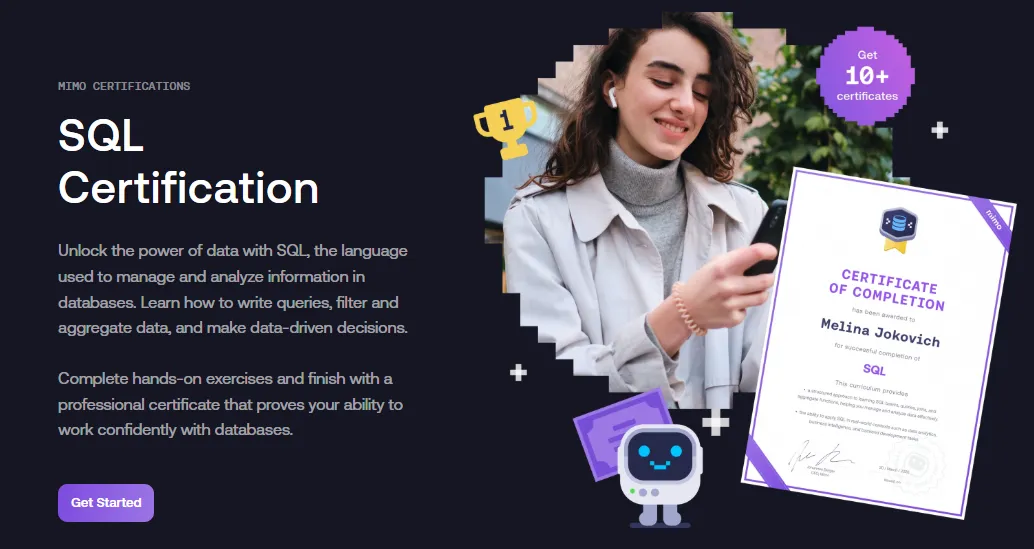
Mimo SQL Certification (Best for Beginners)
Price: Free to start, premium features available
Time to complete: 4-8 weeks
Best for: Complete beginners who want mobile-first learning
Mimo’s SQL certification excels at teaching fundamentals through bite-sized lessons you can complete on your phone during lunch breaks or commutes.
The curriculum covers everything from basic SELECT queries to complex JOINs and subqueries. What makes Mimo effective for beginners is the AI integration. You’re not just reading syntax examples. The AI assistant helps debug your code in real-time, explains concepts in plain English when you’re stuck, and adapts to your learning pace.
You’ll work through core SQL concepts like filtering, grouping, joins, and subqueries using short, hands-on exercises instead of long lectures. Over time, that turns into real hands-on experience you can point to in interviews as genuine practical application of what you’ve learned. Because you’re querying realistic sample datasets, the transition to company data later feels like a natural next step rather than a shock.
Verdict: If you’re starting from absolute zero, Mimo offers accessible, AI-powered learning that builds genuine SQL skills. The mobile-first approach means you can learn consistently instead of waiting for those mythical “free weekends” that never materialize.
Codecademy Learn SQL Course and Certificate
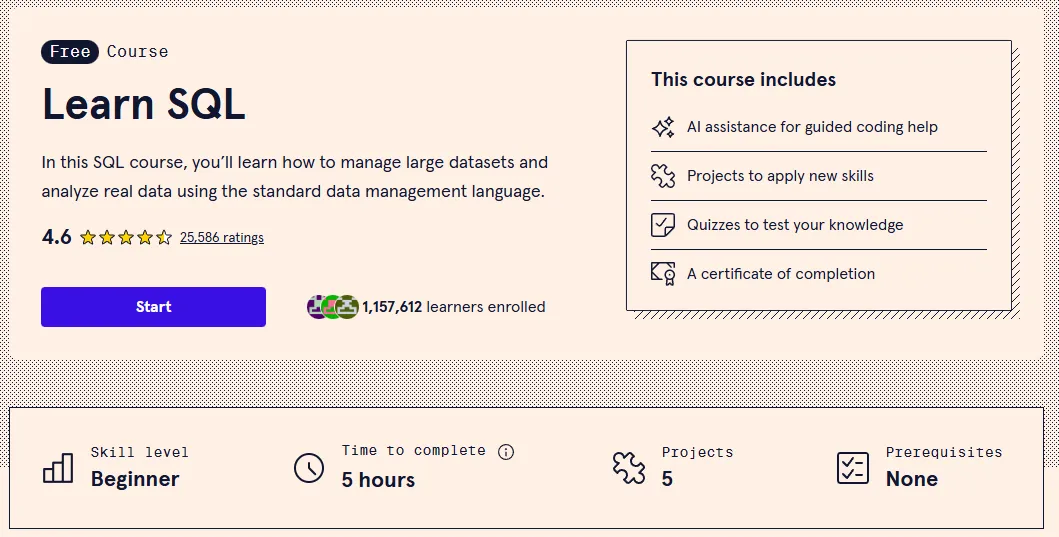
Price: $19.99/month (Pro subscription)
Time to complete: 10-15 hours
Best for: Interactive learners who prefer browser-based practice
Codecademy’s approach is straightforward: learn by doing. You write queries directly in the browser, get instant feedback, and progress through increasingly complex challenges.
The Learn SQL course covers basics (SELECT, WHERE, JOIN) through advanced concepts like aggregate functions and multiple table queries. The interactive environment removes friction—no downloading software, no configuration headaches.
However, the certificate itself carries minimal weight with employers. Think of it as proof you completed the coursework, not proof you’re job-ready. You’ll still need to build projects independently to demonstrate real competence.
Coursera SQL Certifications
Coursera offers multiple SQL learning paths from major universities and tech companies:
Google Data Analytics Professional Certificate
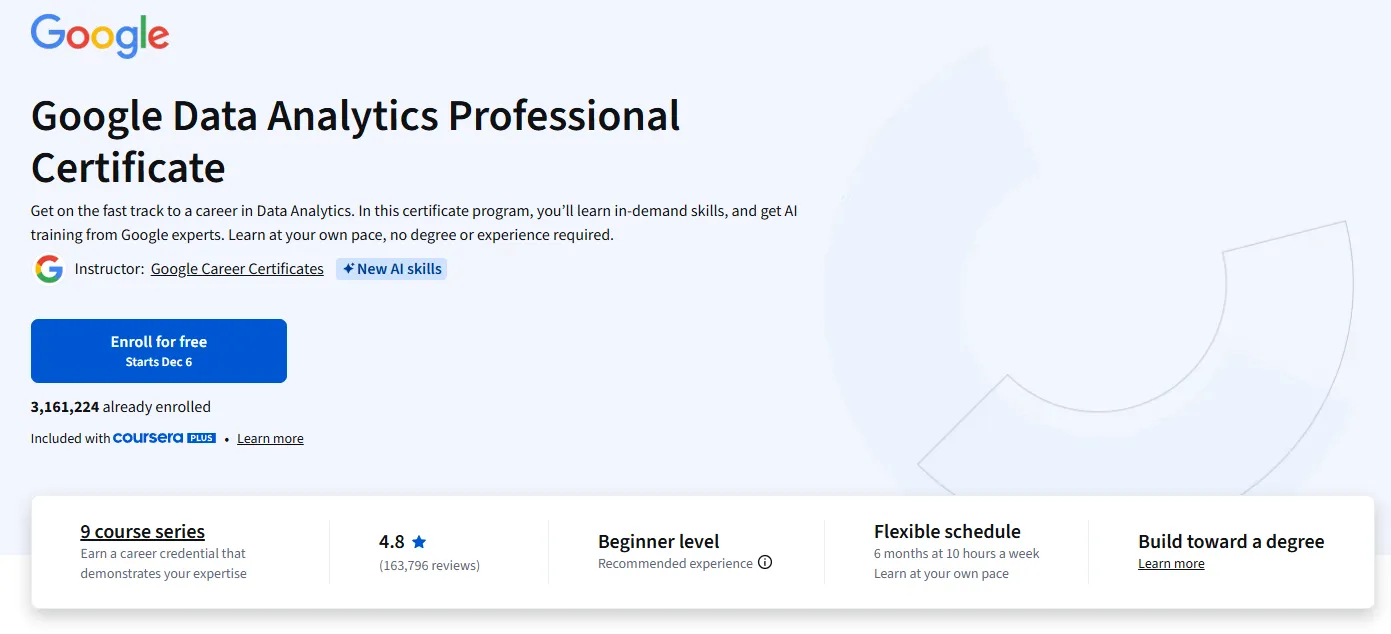
Price: $49/month subscription
Time to complete: 6 months at 10 hours/week
Best for: Complete beginners wanting structured learning
The Google Data Analytics Professional Certificate has become the default starting point for millions of aspiring analysts. The program covers the full data analysis lifecycle: spreadsheets, SQL, R programming, Tableau, and professional presentation skills.
The programming language choice is worth noting. The original Data Analytics certificate teaches R instead of Python. The job market overwhelmingly prefers Python for data engineering and machine learning. However, Google addressed this gap with the Advanced Data Analytics Professional Certificate (launched in 2023), which focuses specifically on Python. If you’re choosing between the two, the Advanced certificate aligns better with current industry demands.
The SQL training in both programs is foundational. You’ll master basic syntax but stop short of complex queries that appear in technical interviews—correlated subqueries, advanced window functions, query optimization.
IBM Data Analyst Professional Certificate
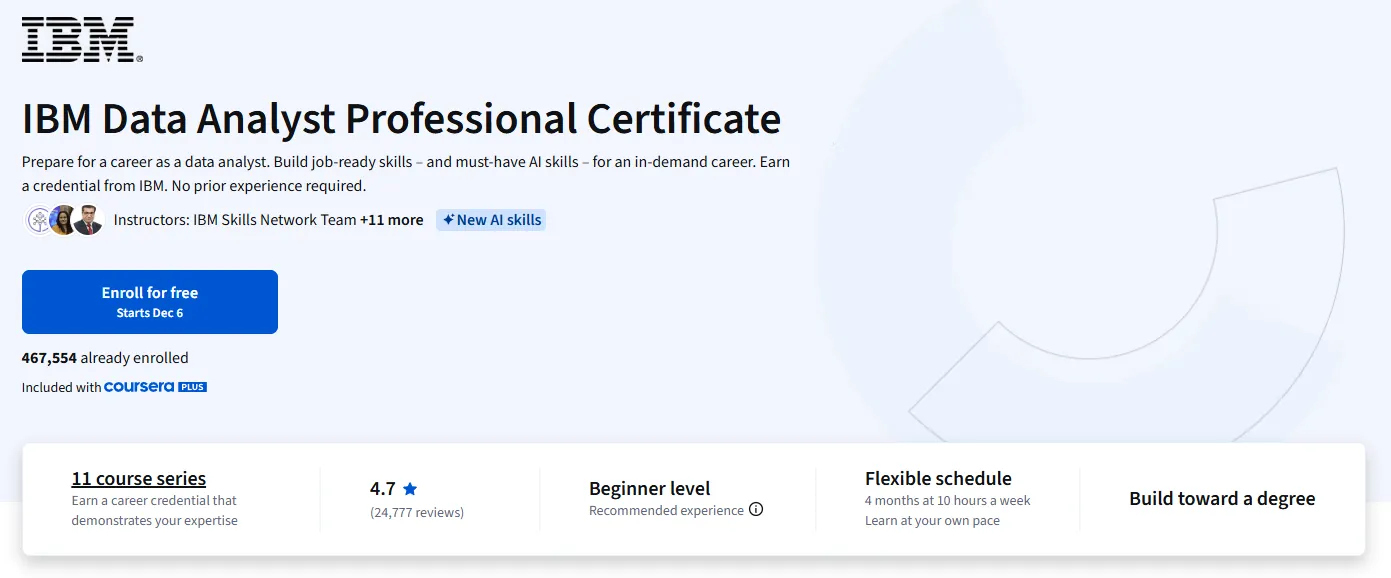
Price: $49/month subscription
Time to complete: 5-6 months
Best for: Python-focused learners
IBM’s main differentiator is teaching Python instead of R, aligning better with current industry trends. The IBM Data Analyst Professional Certificate program covers Python, SQL, Excel, and IBM Cognos Analytics.
The Cognos inclusion is a double-edged sword. While it exposes you to enterprise BI tools, Cognos has significantly smaller market share compared to Tableau or Power BI. The specific tool training doesn’t transfer as readily.
Like the Google certificate, this functions as a “completion badge.” It helps with resume keyword optimization but doesn’t carry the weight of proctored, vendor-specific technical exams.
Platform Certifications: The Bottom Line
These courses teach valuable skills. They provide structure. They’re affordable. But they’ve become so accessible that they’ve saturated the market. Millions of people hold these credentials, diluting their signaling power.
Use them for education, not just the certificate. The learning is valuable but the credential alone won’t land you a job. You need projects, you need to demonstrate problem-solving ability, and you need to ace the technical interview.
Vendor-Specific SQL Certifications
Moving beyond learning platforms, we enter the vendor-specific certifications that test your ability to work with specific database technologies. These carry more weight with employers but demand more preparation.
Oracle Database SQL Certified Associate (1Z0-071)
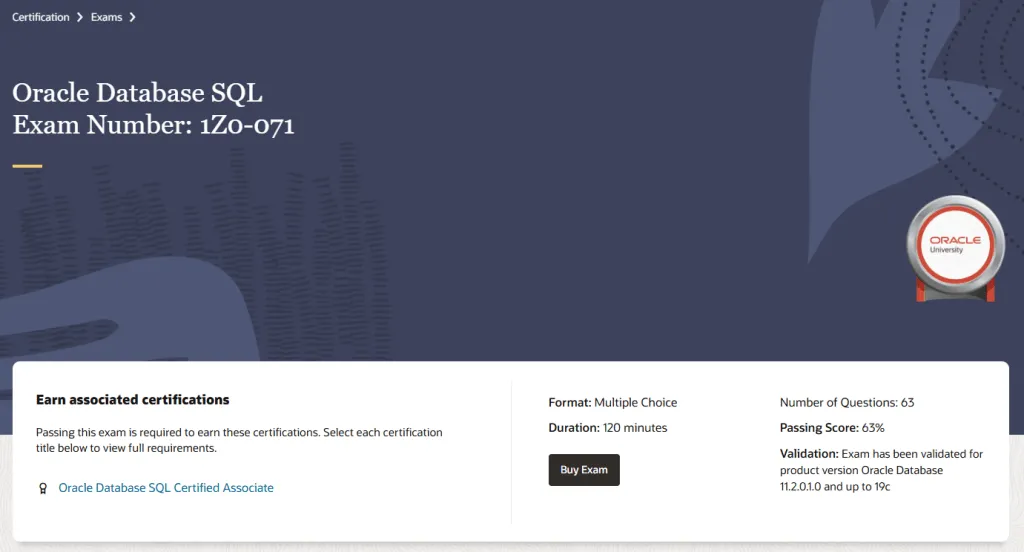
Price: $245 per attempt
Time to complete: 3-6 months preparation
Recertification: Required every 18-24 months
Best for: Database administrators in Oracle-heavy environments
Oracle Database SQL Certified Associate is widely regarded as one of the hardest and most respected SQL certifications available. It’s not just a test of syntax—it’s an endurance trial.
Candidates describe it as “absurdly difficult.” The exam focuses on edge cases that rarely occur in daily work. You might face questions asking you to identify specific error codes for malformed queries or distinguish between nearly identical syntax variations where a single quote placement determines correctness.
Experienced developers with 15+ years of PL/SQL experience report failing because they relied on practical knowledge instead of memorizing the syllabus. The exam tests “textbook Oracle” rather than real-world problem-solving.
Preparation typically requires 3-6 months of study. Successful candidates use official Oracle documentation, specialized Udemy courses, and practice exams to understand the “trick logic” of questions.
For general data analysts, this certification is overkill. But for DBAs and developers in Oracle-heavy industries—banking, telecommunications, government—this is often non-negotiable for employment or promotion. It proves you’re an “Oracle specialist,” not just a “SQL user.” The recurring recertification cost (every 18-24 months) turns this into a subscription rather than a one-time asset.
Microsoft Certifications
Microsoft fundamentally reshaped its certification landscape, killing product-specific credentials in favor of role-based certifications emphasizing Azure cloud integration.
Most of these paths still assume you’ll encounter classic relational database systems such as Microsoft SQL server in corporate environments. Even if your daily work leans more toward reports or dashboards, understanding indexes, views, and stored procedures pays off whenever you collaborate with backend or database development teams who own those production databases.
Azure Data Fundamentals (DP-900)
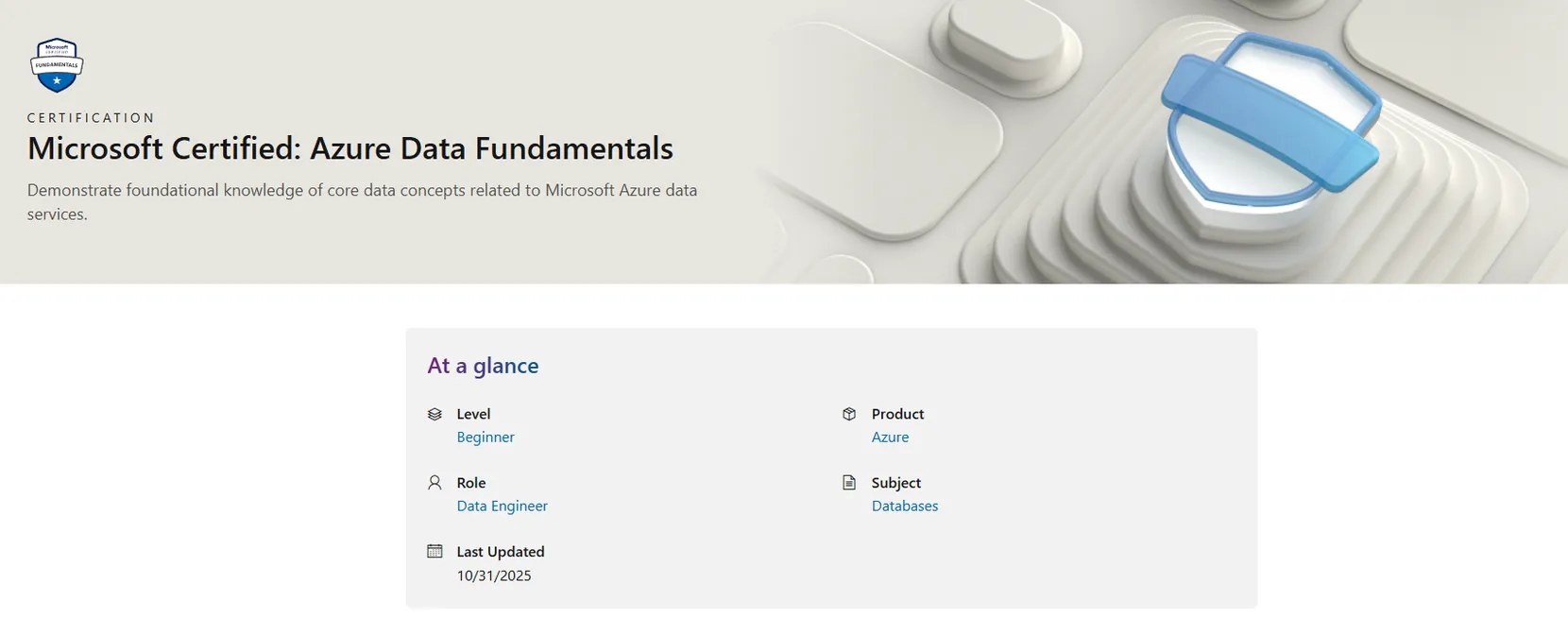
Price: $99
Time to complete: 1-2 weeks preparation
Best for: Non-technical roles or absolute beginners
The industry consensus: this is a “vocabulary test.” Azure Data Fundamentals Certificate is useful for sales, project management, or business analysts who need to understand the difference between SQL and NoSQL, or IaaS vs. PaaS.
For technical hiring managers? Negligible value. It proves you learned definitions, not that you can actually build or maintain databases.
Consider this a stepping stone, not a credential of employability. It’s fine as a first certification to build confidence, but don’t stop here if you want technical roles.
Power BI Data Analyst Associate (PL-300)
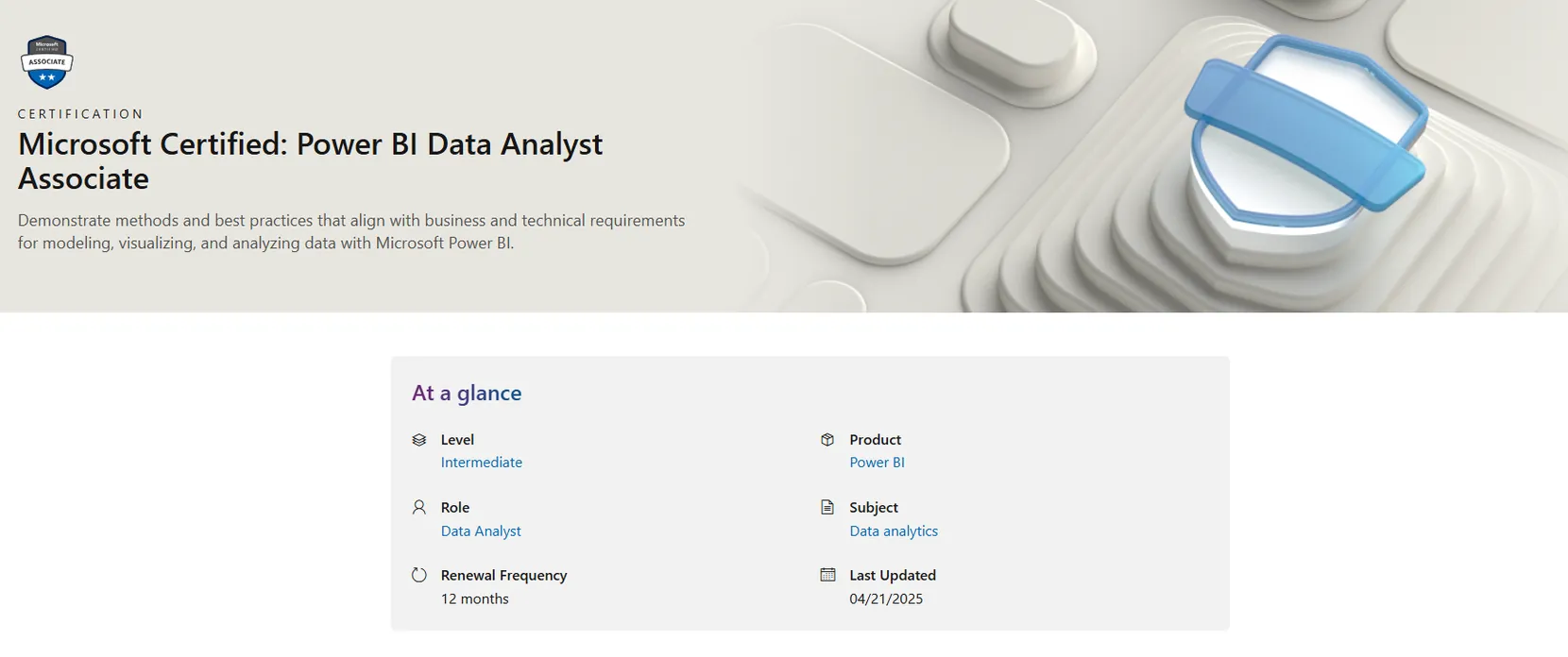
Price: $165
Time to complete: 2-3 months with practice
Best for: Business Intelligence analysts and data visualization specialists
Power BI Data Analyst Associate is the gold standard for analysts working in the Microsoft ecosystem. As Power BI dominates the corporate BI market, this certification demonstrates real, applicable skills.
The exam tests practical scenarios rather than obscure trivia. You need to model data using Star Schema principles, write DAX (Data Analysis Expressions) measures, and deploy reports. A score of 700/1000 is required to pass.
That Star Schema work is real data modeling in practice: deciding how tables relate, which fields belong in dimensions versus fact tables, and how reports should query them efficiently for fast, reliable insights.
Candidates report the exam is moderately difficult but fair. The official Microsoft Learn path is free and comprehensive. Supplement it with practice exams to understand question formats.
Experienced professionals note this doesn’t automatically trigger raises within current companies. But it’s highly effective for getting shortlisted for interviews. It acts as a trusted verifier that you can actually use Power BI, not just claim familiarity.
Azure Database Administrator Associate (DP-300)
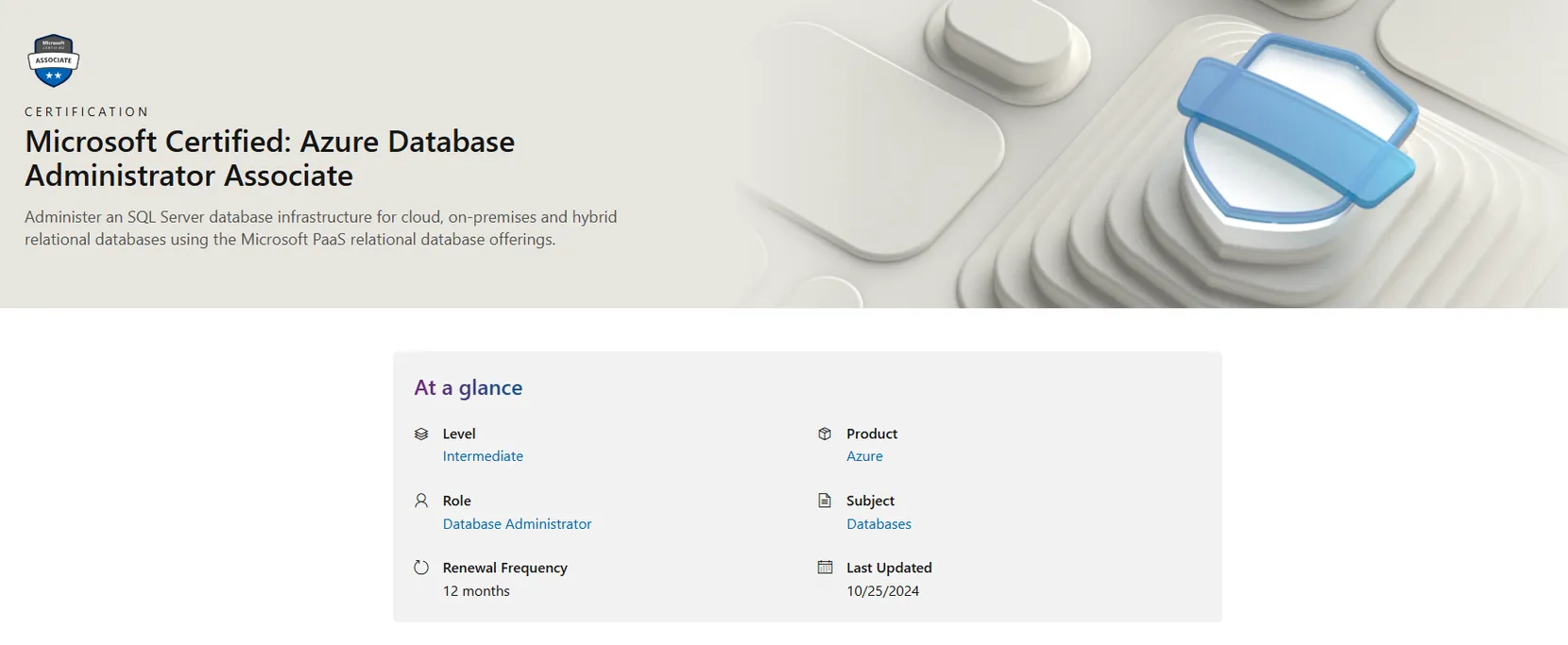
Price: $165
Time to complete: 3-4 months preparation
Best for: SQL Server DBAs transitioning to cloud
Azure Database Administrator Associate replaced the old MCSA SQL Server certifications. The exam covers both on-premise SQL Server and Azure SQL Database management.
Here’s the catch: Microsoft forces you toward cloud even if you work strictly on-premise. You must learn Azure-specific concepts like elastic pools and managed instances to pass. This creates a skills gap where legacy DBAs feel alienated but compelled to adapt.
If you’re a SQL Server professional, this is your path to remaining certified and relevant. The cloud migration is inevitable—might as well get ahead of it.
Cloud Data Platform Certifications
The industry is migrating from on-premise servers to cloud data platforms. These certifications signal competence in modern architectural patterns like separation of compute and storage.
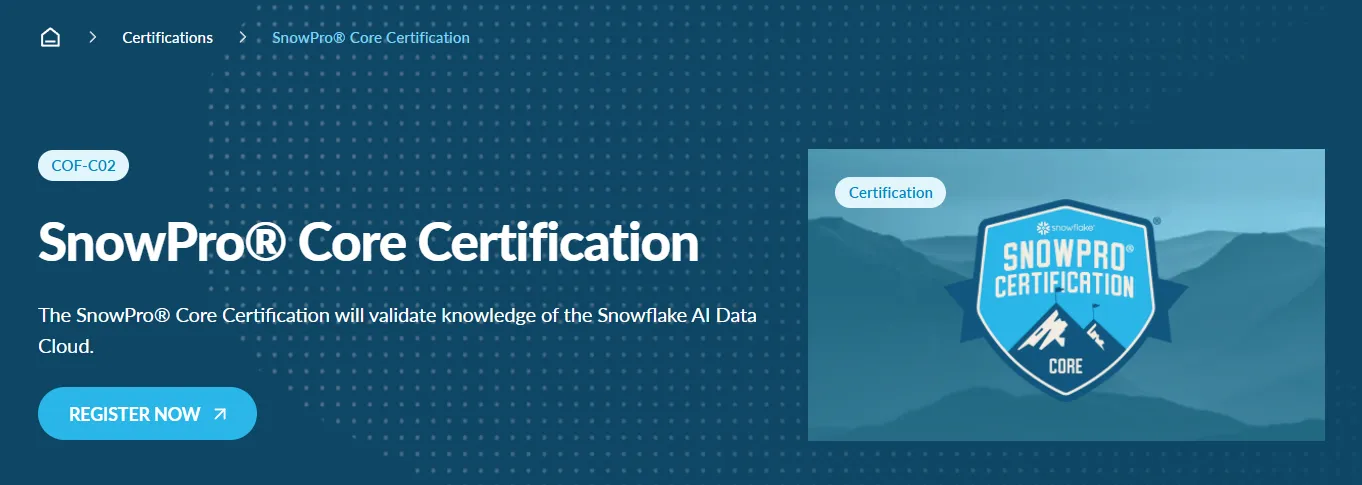
Snowflake SnowPro Core (COF-C02)
Price: $175 per attempt, $88 for recertification every 2 years
Time to complete: 2-3 months of preparation
Best for: Data engineers and analysts working in modern data stacks
The SnowPro Core is the entry point into Snowflake’s ecosystem and a prerequisite for advanced certifications.
The exam consists of 100 multiple-choice questions over 115 minutes. It focuses heavily on Snowflake-specific architecture: micro-partitions, virtual warehouses, credit usage, Time Travel, and Zero-Copy Cloning. You’re not primarily writing SQL, you’re proving you understand how to manage Snowflake environments efficiently.
Salary Impact: There’s debate about ROI. Some users report doubling their salary, but context matters. They typically moved from legacy roles to modern cloud architect positions. The certification was the catalyst, not the sole reason.
For consultants, this is particularly valuable. The badge allows higher billing rates and access to “Snowflake Partner” firm opportunities.
Databricks Certified Data Analyst and Engineer
Price: $200 per exam
Time to complete: 2-4 months preparation
Best for: Data professionals working with lakehouse architecture
Databricks certifications are viewed as highly technical and rigorous. The Data Analyst Associate exam costs $200 and includes 45 questions over 90 minutes.
It tests SQL ability within Databricks SQL environment, focusing on visualization, dashboarding, and data management via Unity Catalog.
The cost barrier: official instructor-led training can exceed $1,000. Many candidates rely on self-study or employer-funded training. This high barrier creates scarcity of certified professionals, potentially inflating the credential’s market value.
2026 Outlook: Databricks is aggressively updating exams to emphasize Unity Catalog, Delta Lake, and AI-driven features. The shift signals increased focus on governance and AI integration.
Specialized Certifications for Advanced Roles
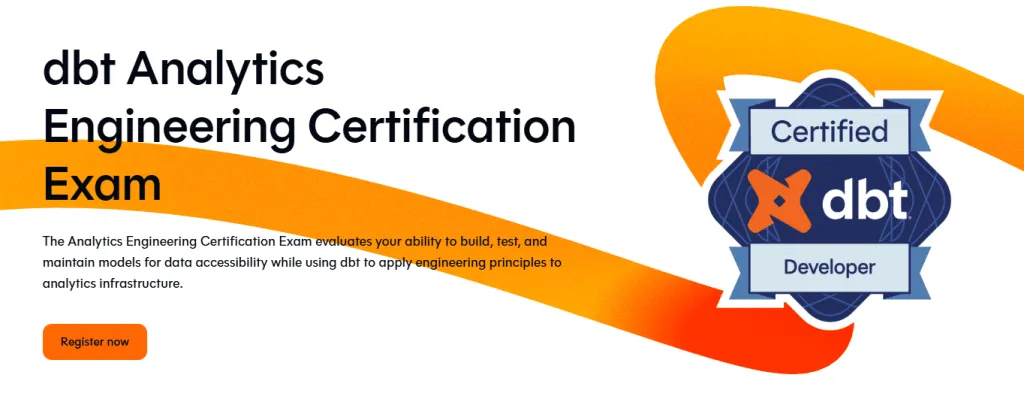
dbt Analytics Engineering Certification
Price: $200, valid for 2 years
Time to complete: 3-6 months (assumes daily dbt experience)
Best for: Analytics engineers building scalable data pipelines
dbt Analytics Engineering Certification defines the emerging “Analytics Engineer” role—a hybrid bridging data analysis and data engineering.
The exam is notorious for difficulty, not from code complexity but question ambiguity. It tests software engineering principles applied to SQL: version control (Git), testing strategies, documentation, and Jinja templating.
Users with over a year of daily dbt experience report struggling because the exam tests “textbook best practices” that may differ from real-world shortcuts. It forces you to unlearn bad habits.
The pass rate hovers around 65%. The exam is proctored online.
Value: This strongly differentiates mid-level professionals. It signals you’re not just writing queries—you’re building maintainable, scalable pipelines. Highly valued in startups and tech-forward companies using the modern data stack (Fivetran/Snowflake/dbt).
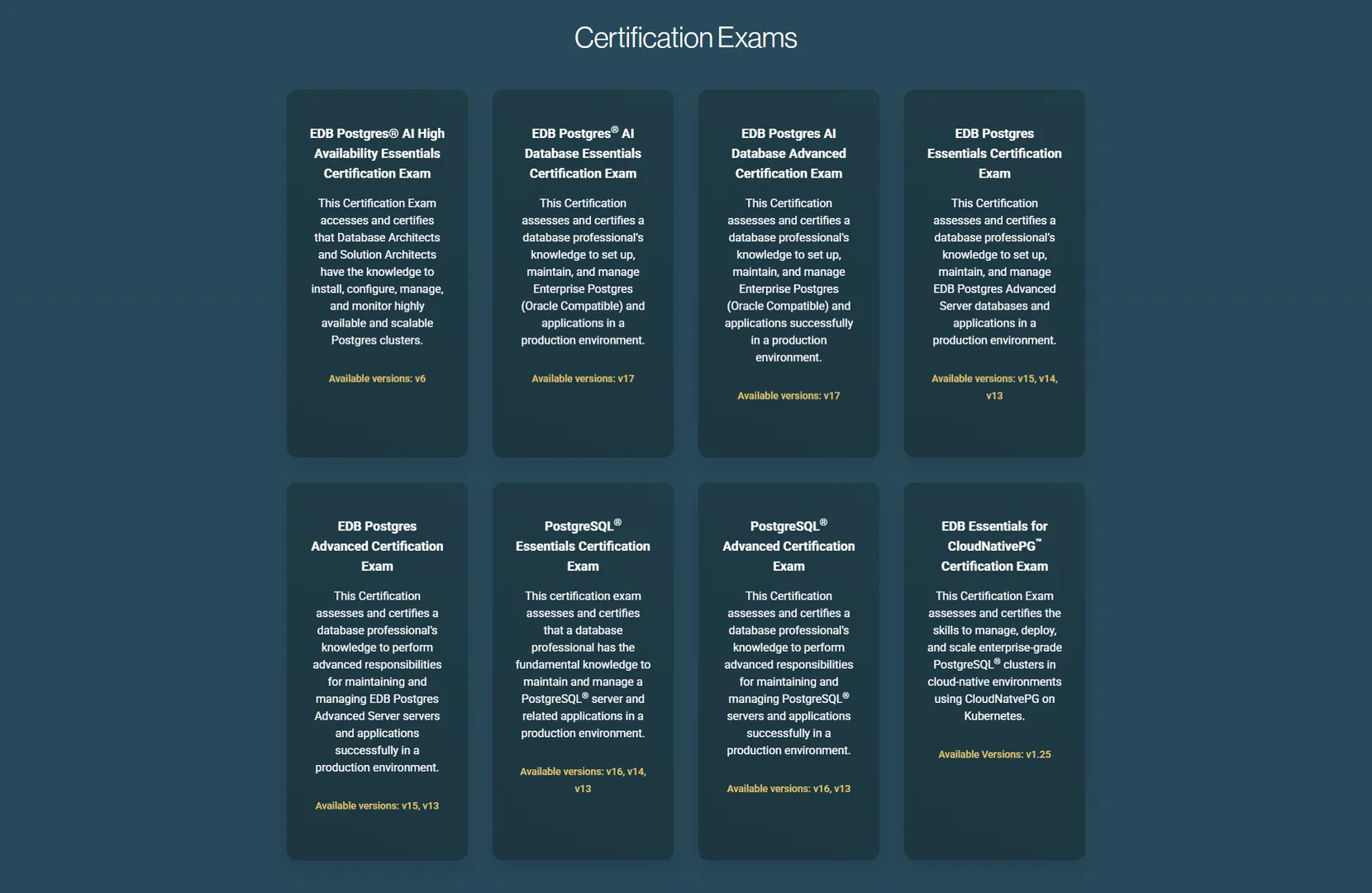
PostgreSQL Certifications (EnterpriseDB)
Price: Varies by level
Best for: DBAs in companies with EDB support contracts
PostgreSQL presents an anomaly. It’s one of the world’s most popular databases but lacks a standardized certification path equivalent to Oracle or Microsoft.
EnterpriseDB (EDB) offers Associate and Professional certifications. The market consensus: these are niche. They’re valuable primarily for DBAs in large enterprises with EDB support contracts.
For the broader market, PostgreSQL certification carries little weight. The Postgres community values contribution over credentials: mailing list activity, patch submissions, technical blogs.
Career Advice: If you focus on Postgres, build reputation through expertise and community involvement rather than chasing certifications. Experience is the true currency in this ecosystem.
Free SQL Certification Options
If budget is a constraint, several free options exist:
W3Schools SQL Certificate: Free learning content, but the actual certificate costs approximately $95. The browser-based testing covers SQL fundamentals. Carries minimal industry credibility but useful for self-assessment.
Microsoft Learn: Completely free learning paths for Azure certifications. You only pay for the exam itself ($99-165).
DataCamp Free Tier: Limited free access to courses. Monthly subscription unlocks full platform.
Remember: free learning resources are excellent for building skills, but recognized paid certifications typically carry more weight in job applications. Use free platforms to learn, then consider investing in vendor-specific credentials for maximum career impact.
How to Choose Your SQL Certification Path
Your certification strategy should align with your career goals and current situation:
Path 1: The Career Switcher
Goal: Land first data analyst role
Timeline: 3-6 months
Strategy:
- Start with Mimo SQL Certification for foundational skills and flexible mobile learning
- Progress to Microsoft PL-300 (Power BI) for professional credibility—this has the highest ROI for entry-level positions
- Build portfolio with 3 projects: one using SQL to clean messy data, one demonstrating visualization skills
- Skip expensive Oracle or specialized engineering certifications at this stage
The key is layering: Mimo builds your skills quickly, PL-300 proves them professionally, and projects demonstrate you can apply both.
Path 2: The Data Engineer
Goal: Build scalable data pipelines
Timeline: 6-12 months
Strategy:
- Establish cloud foundation: AWS Certified Data Engineer or Azure Data Engineer (DP-203)
- Add platform specialization: SnowPro Core or Databricks Data Engineer (based on target employer tech stacks)
- Differentiate with dbt Analytics Engineering Certification
- Focus on understanding the “T” in ELT and modern software practices
Path 3: The Legacy DBA
Goal: Modernize skills and remain employable
Timeline: 6-12 months
Strategy:
- Transition from on-premise certifications to Azure Admin (DP-300) or Oracle Cloud Infrastructure
- Learn PostgreSQL in depth as, even without certification, managing Postgres on RDS/Aurora is critical as companies migrate from licensing fees
- Consider infrastructure certifications (Terraform, Ansible) over additional SQL certificates since modern DBAs are infrastructure engineers
Is SQL Certification Actually Worth It?
The answer depends entirely on your career stage.
Entry-Level Candidates
Certifications don’t generate salary premiums, but they generate opportunity. They’re binary filters: without them, your resume gets rejected. With them, the interview process begins.
The ROI is infinite if it leads to your first job, even if that job pays standard market rate.
Experienced Professionals
Certifications rarely trigger automatic raises within current companies. Instead, they provide leverage for mobility.
The pattern: You get certified. You ask for a raise. Your current employer declines (viewing the certificate as irrelevant to current tasks). You apply to consultancies or competitors who value the certification for partnership reasons. The new offer includes a significant pay bump (e.g., $100k to $150k).
The certification didn’t increase your labor value at the current company. It increased your liquidity in the open market.
Common Questions About SQL Certifications
Can I learn SQL and get certified without a degree?
Absolutely. SQL certifications don’t require college degrees. Many successful data professionals entered the field through self-study and certifications.
Career switchers from hospitality, retail, supply chain, and other non-technical backgrounds have successfully transitioned into data roles by combining certifications with portfolio projects.
The key is pairing the credential with domain knowledge from your previous career as this combination validates both technical skill and business acumen.
Is SQL still in demand in 2026?
Absolutely. SQL remains the universal language for working with data. While new technologies emerge constantly, relational databases power the majority of business applications.
Every data role, from analyst, engineer, to scientist, requires SQL proficiency. According to job market analysis, SQL consistently ranks among the top 5 most requested technical skills. The demand isn’t shrinking; it’s evolving.
Modern SQL now includes cloud platforms, distributed systems, and integration with machine learning workflows.
Will SQL be replaced with AI?
It won’t be replaced, but it will be augmented. AI tools like ChatGPT and GitHub Copilot can generate SQL queries from natural language descriptions.
This commoditizes basic syntax but doesn’t eliminate the need for SQL expertise. Someone still needs to validate the AI-generated query is correct, optimized, and secure. The value shifts from memorizing syntax to understanding data architecture, query optimization, and logical reasoning.
AI makes beginners more productive faster, but expert SQL knowledge becomes more valuable, not less. Certifications now validate you understand the “why” behind queries, not just the “how.”
Conclusion
SQL certifications work as career accelerators, not magic bullets. They unlock doors for beginners, generate partnership value for consultancies, and serve as gatekeepers in enterprise environments. But the credential itself is just the beginning.
The market has shifted. AI can generate basic queries, making syntax memorization less valuable. What certifications now validate is what AI can’t replicate like architectural thinking, query optimization logic, and the judgment to know when a subquery beats a join.
Your move depends on where you stand. Breaking in? Get certified and build projects. Already established? Certify strategically for mobility. Switching careers? Use the certification as your conversation starter, not your only talking point.
Skip the credential collecting. Pick one or two that align with your target role, pass them, then get back to solving real problems. That’s where actual learning happens.
Ready to start your SQL certification journey? Begin with Mimo’s SQL certification—learn at your own pace with AI-powered assistance, build practical projects, and earn a recognized credential that proves you’re serious about data.